

I wish I could take credit for it.
Unfortunately, I had nothing to do with its success.
I’m talking about one of my favorite creative client’s recent triumph, a mega-viral video by the brilliant Annie Sertich that now has over 30 million views across platforms and over 1 million shares on Instagram.
Her character Gwen is featured in a series of faux-1980s video dating tapes that parody the awkward, earnest nature of early video dating services.
In the first five seconds — with brilliant comic riffs — she nails the traditional definition of Integrity, which is this month’s theme.
(Meditation HERE.)
It’s best to listen to Gwen tell it, of course, but to quote her wisdom:
“My ideal man doesn’t play the drums.
Doesn’t stay late at the bar.
Does what he says and says what he does.
Does not get a fancy lawyer that the other person can’t afford
(if things get weird).

You must watch the full video HERE
Gwen has nailed the classic definition of doing what you say and saying what you do.
In fact, this morning I even found a version of the same idea on the oracle card from the dog deck my friend Robbie gave me:
Integrity:
If you fetched this card, it means you’re being called to say what you mean, mean what you say, do what you say, and follow through.
Perhaps you’ve let your tail wag you instead of the other way around.
Going deeper into this idea, Brandon Procak, in Your Mind, Your Universe: A Science-Based Guide to Conscious Creation and Intentional Living, writes that:
Integrity means that your thoughts do not betray your heart.
That your emotions do not contradict your actions.
That your words reflect your beliefs, and your beliefs reflect your soul.
Using the common image of integrity as a compass that directs us toward our true north, he quotes Emerson, who wrote:
“Nothing is at last sacred
but the integrity of your own mind.”
Yet challenging as it is, however, let’s be honest:
Integrity is exponentially easier when you’re alone.
The bigger test is whether you can remain true to yourself when other people are involved.
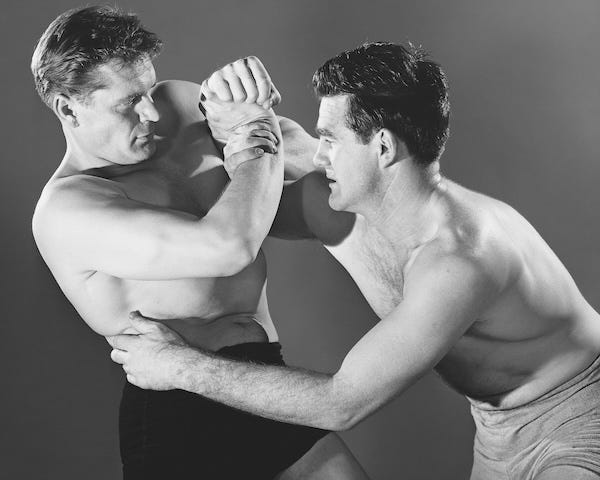
Two prominent authors recently had a semi-public dispute over endorsing one another’s projects.
Each had endorsed the other’s very successful books and offerings multiple times.
Things hit a massive speed bump, however, when one of them disagreed with the content of the other’s new project.
The author who declined to endorse felt that their integrity was best preserved by remaining silent.
This did not go over well.
The first author felt that you should endorse your friend’s project in the same way that one must always compliment the bride on her wedding day.
Indeed, when someone’s marching down the aisle, it’s not really the time or place to give a critique of the bridal gown.
I was definitely not consulted, but if I had been asked for my advice, I think some creativity might have softened the rigidity and made things much more interesting, while still preserving the second author’s integrity.
Why not offer an endorsement like:
“I’m a huge fan of so-and-so,
and this book presents ideas that are completely contrary to my own.
Therefore, I think it’s particularly interesting and worth a read.”
Speaking of creative integrity and compromise …
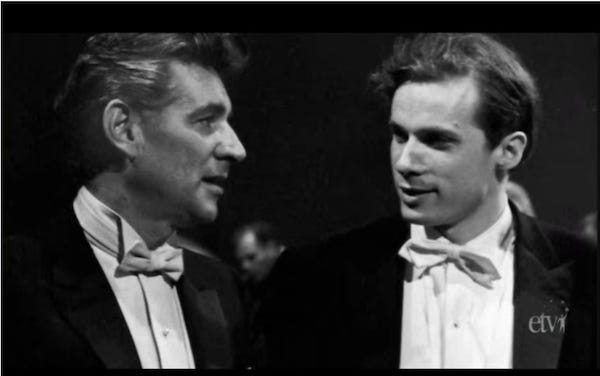
On April 6, 1962, Leonard Bernstein did something almost unheard of in the world of classical performance.
Before conducting the New York Philharmonic in a performance of Brahms’s Piano Concerto No. 1 in D minor with the legendary pianist Glenn Gould at Carnegie Hall, he addressed the audience directly.
Essentially, he announced to the audience that he did not fully agree with Gould’s conception of the work, which he found extremely unorthodox — especially because of Gould’s very slow tempi and major interpretive liberties.
He then admitted:
“This raises the interesting question, what am I doing conducting it?
I’m conducting it because Mr. Gould is so valid and serious an artist that I must take seriously anything he conceives in good faith.
And his conception is interesting enough so that I feel you should hear it too.
He went on to say, prompting audience laughter:
I have only once before in my life had to submit to a soloist’s wholly new and incompatible concept, and that was the last time I accompanied Mr. Gould.
After raising the question once more of “why am I conducting this,” he declared that “there are moments in Mr. Gould’s performance that emerge with astonishing freshness and conviction” and that “we can all learn something from this extraordinary artist who is a thinking performer.”
Before picking up the baton, Bernstein concludes by saying that it had been a week of adventure collaborating with Gould on this Brahms concerto, and that “it’s in this spirit of adventure that we now present it to you.”
You can hear the speech and the performance HERE.

I’m reminded of a poem I love by Antonio Machado, translated here by Mary G. Berg and Dennis Maloney.
It offers perhaps a more poetic view of Gwen’s walking the walk, and yet it also echoes her longing for connection.
[Traveler, your footprints]
Traveler, your footprints
are the only road, nothing else.
Traveler, there is no road;
you make your own path as you walk.
As you walk, you make your own road,
and when you look back
you see the path
you will never travel again.
Traveler, there is no road;
only a ship’s wake on the sea.
Machado tells us that integrity is not just “walking the walk,” but carving out the road itself.
Integrity is evidence left over time, the path our actions leave behind.

Integrity may be easy to define, yet difficult to live.
Sometimes, squabbling authors miss the point — and the opportunity — to honor truths that don’t align with their own worldviews.
Other times, great artists like Bernstein and Gould manage to do this, even when Bernstein admits he needs to make “a small disclaimer” up front.
When asked why she wants to find love, Annie’s character Gwen says:
“I just think that everybody deserves a second chance.
I want to go to the PTA with somebody, not just myself.”
Integrity as a solo journey, while challenging, is indeed much easier.
But as Bernstein noted before diving into the Brahms concerto, it is so much less of an adventure.
Tell A New Story. Transform Your Life.

Here’s more from that dog card on Integrity:
Now is the time to focus more of your attention on the parts of your life that don’t feel right or in alignment for you. You can get help with that if you ask for it, beginning with letting others know that this is a place of struggle for you. True friends, mentors, and coaches can help you pull the pieces together, perhaps in a new way that’s a better fit for who you truly are.
In that spirit, the 1:1 consults with me offered with the new course were claimed so quickly last Sunday that I’ve opened up a few more for this week.