

It may not just be the Mercury retrograde that’s thrown me off course.
The theme I’m exploring this month — Getting in the Reps; Meditation HERE — has provoked a lot of stories.
In particular, I’ve been remembering two friends from a lifetime ago who were — rather ironically — perhaps the most and the least talented actors I’ve met.
And that is really saying something:
I’ve cast actors in my script readings who went on to win Oscars, Emmys, and Tonys — and, at the other extreme, actors who left the business minutes after getting their first headshots.

The talented one was truly brilliant.
Standing ovations were par for the course.
Yet they were quite literally always moving, never staying in one place long enough for the work to compound or for them to gain a foothold in a notoriously precarious industry.
I’ll walk away from any analysis of whatever motivated that movement, yet the result was undeniable:
Success could never truly take root.

The other actor was entirely the opposite.
Even though their spark of talent was perhaps modest, they were unfailingly consistent.
They were profoundly and utterly committed to their career path, refusing to ever give up.
That, however, was not their undoing.
Despite decades without success, they refused to take feedback or change anything in their approach.
Persistence was their greatest virtue, yet it yielded no rewards.
Yes, Getting in the Reps may be essential to success, but this actor embodied Emerson’s famous warning:
“A foolish consistency
is the hobgoblin of little minds.”

This brings me to my central question:
How do you know whether you should persevere through the difficult middlerather than change course — or whether you’re merely traveling further and further in the wrong direction?
Julia Cameron’s The Vein of Gold suggests that the gold already exists inside us.
The creative practice is therefore a form of excavation, one where we keep digging long enough to discover the inner riches, the ones that are just out of reach.
Decades earlier, Napoleon Hill shared a similar idea in a section of Think and Grow Rich titled “Three Feet from Gold.”

Set during the gold-rush era, the story follows a man whose uncle headed west convinced he would strike it rich.
After an initial discovery, they lost the vein.
Repeated attempts to find it failed again and again.
Giving up, they sold the mining equipment to a scrap dealer, who hired an engineer.
Gold was soon found three feet from where they had stopped.
The story illustrates that temporary defeat can look exactly like a dead end — even when it isn’t one.
Success may just be a few feet — or a few rejections — away.
®Napoleon Hill’s account is best regarded as a parable about success — but sometimes the invisible and unknowable proximity to success can be quite real.

In 1908, a British-backed expedition led by George Reynolds had spent years drilling for oil in Persia with almost nothing to show for it.
Money was running out, workers were being dismissed, and Reynolds had received instructions to shut the operation down.
Instead, he delayed obeying them and continued drilling.
At 4:00 a.m. on May 26, the drill reached roughly 1,180 feet—and oil erupted high above the rig.
The discovery at Masjed Soleyman became the first major commercial oil strike in the Middle East and led to the company that eventually became BP.
Reynolds didn’t simply strike oil just before giving up.
He struck it because, even after being told to stop, he kept digging.
It’s worth bearing in mind, however, that another story offers the opposite lesson.
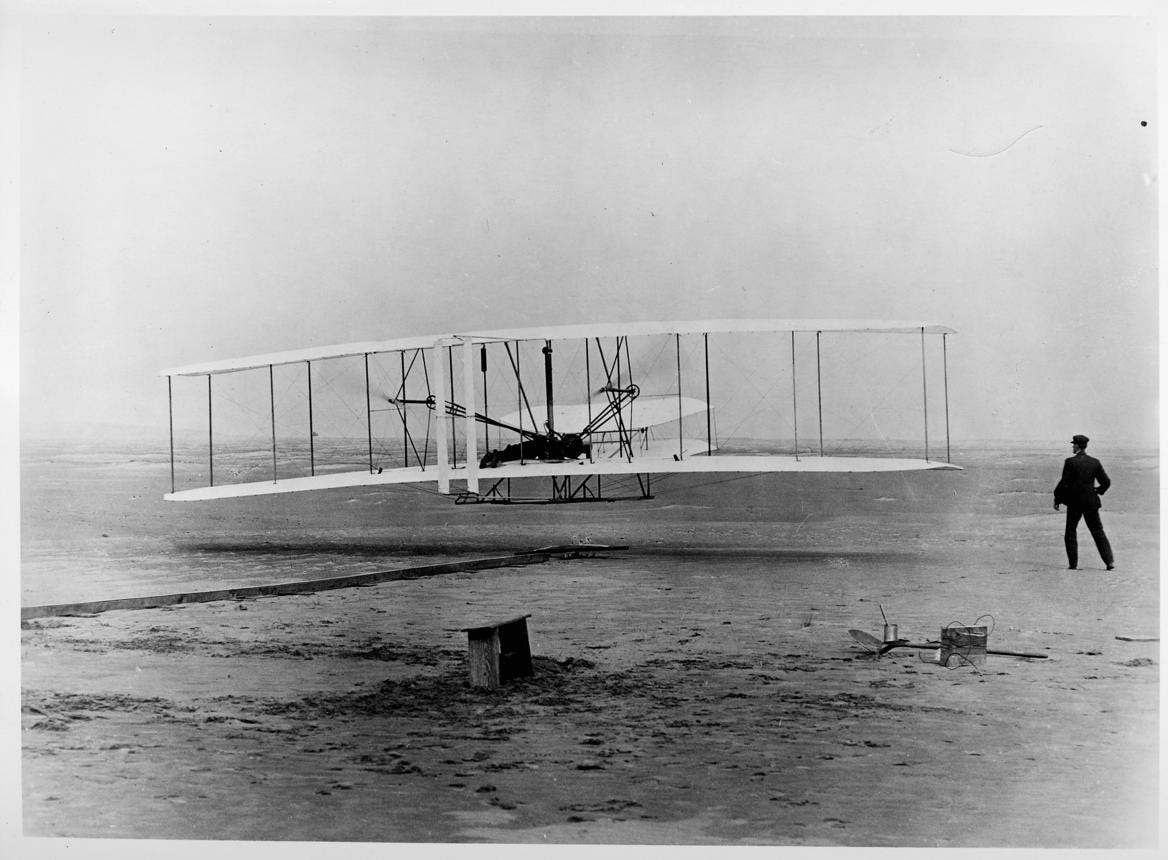
In 1903, Samuel Langley, the distinguished secretary of the Smithsonian, was trying to build a pilot-carrying airplane.
His attention was focused almost entirely on producing sufficient power to get the machine into the air.
To that end, he created an impressive full-scale Aerodrome, but after it crashed twice — the second time on December 8, 1903 — he abandoned the work.
Nine days later, the Wright brothers succeeded.
According to NASA’s website, one crucial difference was that the Wrights identified control, not merely power or lift, as the hardest problem.
They repeatedly tested gliders, discovered that some accepted aerodynamic data was inaccurate, built a wind tunnel, corrected their assumptions, and developed active control over roll, pitch, and yaw before adding an engine.
Essentially, the Wright brothers proved that sometimes the obstacle isn’t a lack of persistence.
Sometimes what prevents you from taking off is a false premise at the start — and a refusal to course-correct.

Indeed, a tiny error, repeated consistently, can take you thousands of miles from the destination.
That starting mistake compounds over distance and time.
Using NASA’s figure for the Moon’s average distance from Earth — 238,855 miles — a one-degree error would leave you roughly 4,170 miles off course.
Basically, if you’re off course, getting in the reps can make things a lot worse.
Even an error of 0.1 degree would mean missing the Moon by 417 miles — or, like Actor #2, never getting a callback.

Getting in the Reps (again, Meditation HERE) is essential, but it’s more important to stay committed to the destination — not necessarily to the method.
Perpetual movement without consistency can leave a fortune in gold unmined, perhaps mere inches out of reach.
On the other hand, persistence without reflection becomes a truly foolish consistency, hammering away with no end in sight.
In the end, the trick is to keep digging — but also to keep our eyes open.
Ultimately, each life requires its own judgment about which virtue is needed: persistence or course correction.
Fittingly, I think Theodore Roethke’s poem “The Waking” might summarize this best:
”I wake to sleep, and take my waking slow.
I learn by going where I have to go.”
Tell A New Story. Transform Your Life.