

It was enough of a success that I was tempted to lift several years of radio silence in order to offer a sincere thank you.
Decades ago, a brilliant but complicated person was adamant about how I should style my hair.
In fact, they even offered to accompany me to the barber so that their vision was executed properly.
Sadly, I declined.
But last week, while getting my trim for the summer, when the barber asked how I wanted my hair cut, I found myself issuing their exact request:
Exactly like Harrison Ford’s in Blade Runner.
I think you’ll agree the result is triumphant.
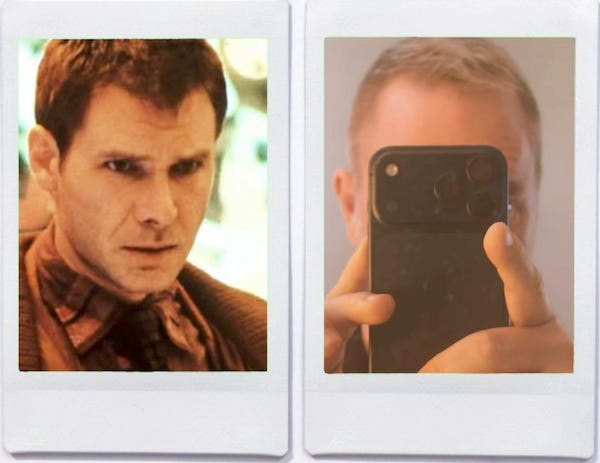
Although seemingly unremarkable, in 1982 this haircut was rather unusual, given that most male movie stars then had more length, feathering, and volume.
It has an unexpected hint of punk vocabulary.
More importantly, Harrison Ford reportedly just went out and got the haircut himself, in part because director Ridley Scott envisioned his character Deckard wearing a big felt hat.
Having just succeeded in Raiders of the Lost Ark, Harrison Ford did not want to become a hat icon.
Even so, according to a People Magazine special issue, Ford had to convince Scott to let him wear this “image-shattering crew cut”because he wanted Deckard to seem like someone who had “given up on himself” and was no longer very conscious of grooming or appearance.
More to the point, it also suits his hard-edged job: hunting replicants, bioengineered humanoids.
I find it particularly fitting — given that this month’s theme is Integrity; meditation HERE — that the occupation of replicant hunter centers on tests of authenticity, all designed to determine whether a constructed self can be considered real.

I’ve been reading a fascinating book by Brandon Procak — Your Mind, After Death: The Case for Consciousness Beyond the Body — and was particularly struck by his section on lucid dreaming.
He defines this as:
Lucid dreaming is a controlled, repeatable state in which consciousness persists and acts intentionally while the body and senses remain offline.
In other words, you are awake inside your dream.
The phenomenon is actually ancient and cross-cultural.
Aristotle wrote about it, and there’s even a branch of Tibetan Dream Yoga I’ve studied.
As I was diving into the book, a member in a reading group I’ve joined offered a link for a free month on an app devoted to mastering lucid dreaming.
Of course, I immediately took advantage of this synchronicity.
The primary technique is extremely simple: set reminders several times each day to ask yourself one question:
Am I dreaming?

With each reminder, you’re instructed to perform a state test in order to develop a habit that will carry over into the dream world.
In other words, you’ll keep asking yourself the question while awake, and then, once asleep, the habit is meant to continue.
At some point, the answer might just be “Yes.”
The first state test they recommend is fascinating to me.
After asking yourself the “Am I Dreaming?” question, look at a piece of writing for a moment and then look away.
Looking back, notice if the text has changed in any way, or if the letters have rearranged themselves on the page.
In our waking state, we associate that kind of consistency with reality, something I both endorse and question.

Last week I shared my friend and client Annie Sertich’s mega-viral video (HERE) where she offered a hilarious version of the classic definition of integrity: doing what you say and saying what you do.
In other words, the words on the page stay the same when you look back at them.
However, in real life people change, positions evolve, dreams update, and entire identities reorganize themselves.
When is changing your mind (or your behavior) healthy evolution … and when is it avoidance, self-abandonment, or, much worse, betrayal?

Last week, I also mentioned the dog deck of oracle cards that my friend Robbie gave me.
That deck has an Integrity card with an interesting subtitle:
Integrity:
Presenting An Altogether You.
That’s such a fascinating and loaded phrase, since “altogether” can mean both whole/coherent and assembled/performed.
Is the “altogether you” that you present the fullest version of yourself … or the most manufactured?
In the age of social media, Deckard might consider this a particularly ironic test of integrity versus replication.
Online, the invitation is to offer a coherent yet glossy and focus-group-approved version of ourselves.
Even “candid” posts these days feel deliberately strategic.
I’m reminded of Truvy — Dolly Parton’s character in Steel Magnolias — who declares:
“There is no such thing as natural beauty.”
Certainly there are worse crimes than zhuzhing things up for a photo op, but still … viewing the “altogether” version of online life as reality can be mind-bending.
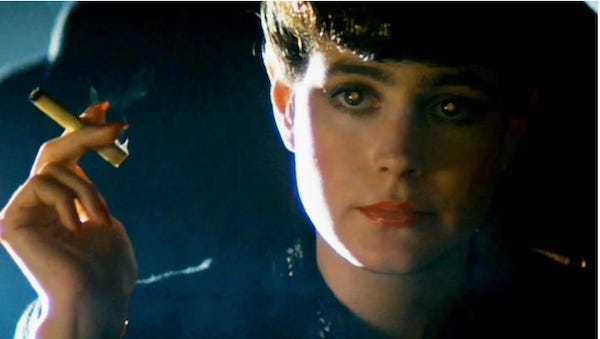
Interestingly, Rachael from Blade Runner (played by Sean Young) actually believes she is human because she has implanted memories.
She has a self-aware, coherent identity, even if it’s artificially constructed.
Beyond this, Harrison Ford and director Ridley Scott remain in disagreement, decades later, over whether Deckard is himself a replicant.
(Ford believes he was playing a human; Scott does not.)
How do we know what’s real — and what does integrity mean when reality, memory, identity, and self-presentation all keep shifting?
I’m not sure why, but the second test the lucid dreaming app offers for determining whether you’re awake or dreaming is far less subtle than letters rearranging themselves on the page.
Without irony, I can report that I also receive several text reminders each day asking me to:
Try to fly or levitate.
So far … no success.
I guess I’m still awake.

I’ve come to realize that integrity may no longer mean consistency for consistency’s sake.
How much wiggle room is required may vary, but integrity may mean remaining in an evolving yet truthful relationship with reality.
Even when that reality changes … or you change … or words rearrange themselves on a page.
Oddly, my willing barber — despite having a massive TV screen in his shop with movies playing all the time — confessed he had never seen Blade Runner.
I had to show him screenshots to get the look.
As many have pointed out, given current advances in robotics and AI, my barber may not need to; we may soon enough be living it.
Dystopian futures aside, I’ve also flirted with breaking years of silence to let my former friend know they were right.
Admitting that an ignored piece of information was always true — and suddenly useful and applicable — reflects both the consistent and evolutionary aspects of integrity, even if the relationship it came from has changed.
It may not prove I’m not a replicant … but I think it comes pretty close.
Tell A New Story. Transform Your Life.

P.S. Since my birthday is this week, I’m opening three Birthday Week Reality Check Sessions.
These are focused 90-minute sessions for anyone whose outer story, inner reality, creative work, visibility, offer, or next identity no longer quite line up.
In other words: if your current life no longer passes your own reality test, this is for you HERE.
We can use the session for writing, reinvention, visibility, creative direction, offer clarity, or simply figuring out what the “altogether you” wants to become next.
Sessions are $250, and I’ll include my Going Deeper course as a birthday gift ($97) for anyone who books this week.