

Lately, I’ve found that the lines between truth vs. fiction and life vs. art are getting even blurrier.
Take, for example, last weekend’s hike with Vlad and a wonderful creative client.
Although we’ve worked together on her five-book children’s series over countless Zoom sessions, we were meeting for the first time IRL.
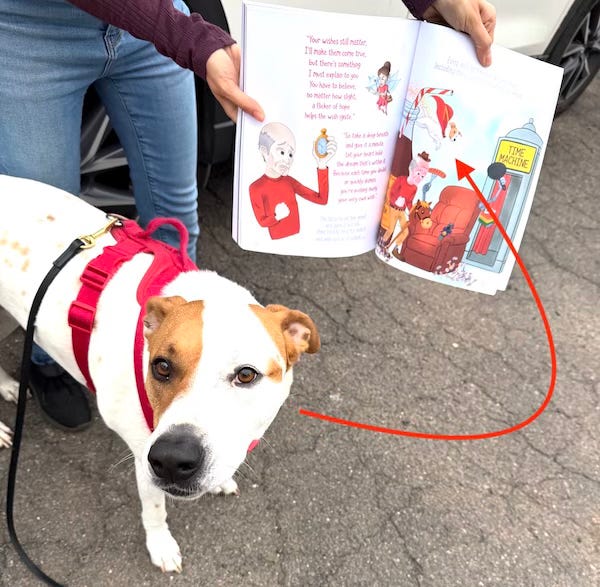
Imagine my delight when she shared with me her book — available HERE — which features Vlad in full super-hero garb.
Somehow, real-life Vlad crossed into her fiction in a way that even I haven’t.
Exploring this month’s theme of Proof — meditation HERE — I can think of no better example of one of its shadow sides than The Shed at Dulwich.
It’s my favorite example of the power and the absurdity of Social Proof.
Started as a joke by freelance journalist Oobah Butler, it was inspired by his experiences writing fake reviews for TripAdvisor restaurants.
Taking things further, with the Shed his goal was to prove how easily reputation systems can be manipulated.
He began to promote a restaurant that didn’t exist — one that was completely fictional — with astonishing results.
Social proof comes from the psychological tendency to look to other people’s behavior or opinions to decide what’s true, valuable, or safe — especially when you’re uncertain or when many choices are presented.
In practice, it shows up as reviews, ratings, testimonials or popularity signals (“#1,” “bestseller,” “most booked”).
The core idea is that if others believe or do it — especially enough of them or the “right” people — it must be the winning option.
When you’re marketing something new, it is, for better or worse, necessary.
For example, I confess that now that we have 50+ five-star Amazon reviews, we recently upgraded the SGR Journal website HERE =to include a carousel that features them.
There’s nothing inherently wrong with this — I’m genuinely proud of the book and sincerely appreciative of all the reviews — but I’m aware that I’m exploiting the system and human nature in my favor.
Speaking of which…

Oobah’s friends wrote a bunch of glowing, very detailed reviews that mimicked real food culture.
Even the photos of the meals were fake but bizarrely convincing.
Made from shaving foam, bleach tablets, sponges, etc. they were styled to look like high-end cuisine.
But Scarcity was the primary marketing strategy for the Shed at Dulwich.
The listing said “by appointment only,” and when people tried to make a reservation, they were told it was fully booked.
Soon the Shed began to rise rapidly in popularity on TripAdvisor — again, a reminder that it did not exist — with even celebrities and their assistants begging for reservations.
Public opinion is a tricky commodity.
Although many years ago I picked up a lot of small change by participating in focus groups, I’ve always had mixed feelings about them.
On a common sense level, of course I understand why you would want to get sample opinions and test the marketplace.
At the same time, nothing is more certain to limit artistic creativity than consensus.
Indeed, Vogue editor Diana Vreeland’s famous maxim was:
“You’re not supposed to give people
what they want,
you’re supposed to give them
what they don’t know they want yet.”
Or, take the famous line widely attributed to Henry Ford:
“If I had asked people what they wanted, they would have said faster horses.”
Exemplifying this, since yesterday was Barbra Streisand’s 84th birthday, there was a flood of well-wishes in my IG feed.
Many of them included reminders that early on, those “in the know” insisted that for her to be successful she had to change her name, change her songs, and change her nose.
Everyone was willing to offer an opinion on how to make her more generic, more traditionally “show-biz.”
Fortunately she listened to none of them.
Focus groups can’t really include genius in their calculations.

Not only did the Shed at Dulwich keep rising in popularity, it actually became TripAdvisor’s #1 restaurant in London.
Simply through the power of social proof, a nonexistent bistro beat out thousands of real restaurants — ones that served real people food and drink.
A lesson in how perception can create a bizarre kind of reality — one in which branding and marketing psychology manufacture credibility — I find it both hilarious and rather troubling.
Going beyond The Emperor’s New Clothes — except without a small child exposing the truth — it’s the Emperor landing on the cover of Vogue.
(Not, I suspect, on Diana Vreeland’s watch.)
In the end, Oobah actually never got “caught” by either the public or TripAdvisor.
Instead, he decided to complete his experiment by making the restaurant real — sort of — for one night.
He invited real guests (who believed it was all legit) and served them cheap supermarket food dressed up as fine dining.
Some of them even praised the food and the entire experience, then left more positive reviews.
Only then did Oobah publish the full story for Vice, explaining how he’d manipulated social proof so brilliantly, creating a triumph out of thin air.
You can even watch his 18-minute video exposé HERE.
Also heavy in my IG feed this week was an example of proof that helped inspire this month’s theme.
Ana Gasteyer actually brought the character she’d created — September L. Davis, an over-the-top Broadway legend starring in a musical version of Proof — to the red carpet for her own Broadway show’s premiere.
Ana stars in Schmigadoon! — itself an affectionate homage to and parody of Golden Age musicals — in a role September swears was stolen from her.
Giving interviews as her character — and even sending herself a video message live on the Today show — Ana Gasteyer blurred the camp / meta lines brilliantly.
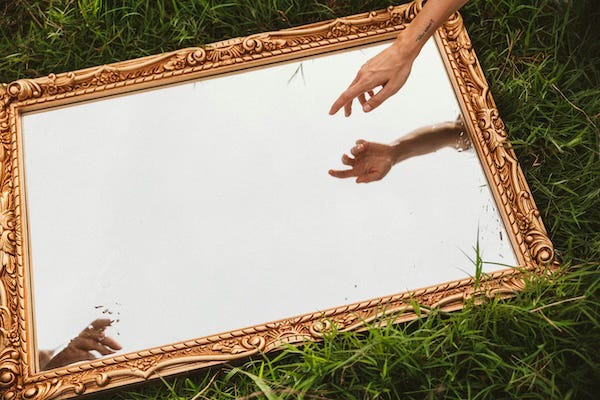
No longer just a social media creation, her character has stepped through the looking glass into the real world.
This week, I also worked with another new client on a fictionalized memoir.
Interestingly, almost all my comments met with the same response:
“That’s exactly the way I had it originally —
until everyone suggested I change it.”
Yes, the opinion of wise critics can be invaluable, but again I challenge you to find any work of genius created by a focus group.
All of this is even more true when it comes to who we are in the world.
Echoing Vreeland and Ford, I love James Baldwin’s wisdom here:
“The place in which I’ll fit
will not exist until I make it.”
Like (fictional) September, we need to be our truest selves, even without the validation of social proof.
The Shed at Dulwich demonstrates that that kind of proof can indeed take you quite far — yet even so, it can never make you real.