

Although I had (wisely) budgeted time for delays, this was one I hadn’t anticipated.
When it comes to publishing mechanics, in my experience, Amazon tends to underpromise and overdeliver.
They told me it would be up to 48 hours for tech approval to order proofs of my new book.
In 4 hours, I had an affirmative response and was able to order the maximum of five.
Thus, having gone through five such pass-throughs while making changes to the manuscripts, when I was able to finally “pull the trigger” this week and make the book live, I thought it could only be smooth sailing ahead.
Alas, I was wrong.

The previous week, I also woke up to something I haven’t felt in years: a dull toothache.
I am extraordinarily (perhaps even delusionally) proud of my dental hygiene as an adult, and so I was taken aback.
Trying to avoid a not impossible but also not entirely easy trip back into the city to my usual dentist, I called my insurance provider to ascertain more local alternatives.
I quickly found that — while I’ve never attempted the latter — getting useful information from my insurance company was more difficult than scaling Mount Everest in a blizzard.
While the pain was still hovering at the dull-throb level, I managed to track down a well-reviewed dentist who took my insurance a two-hour drive away.
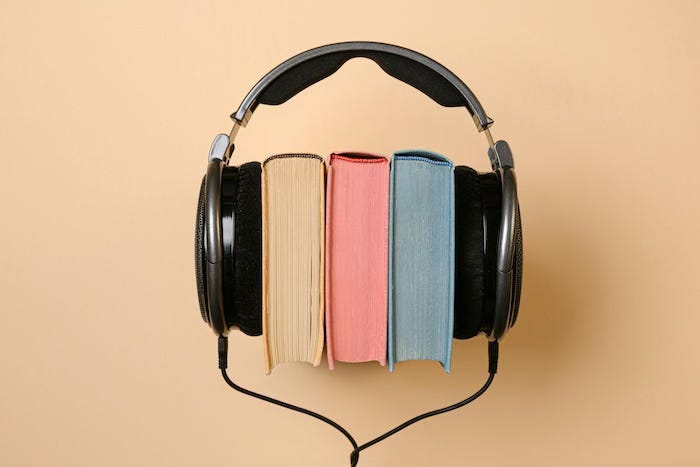
While this definitely beat the four hours each way I’d have to budget for my usual NYC office, it was still an unscheduled trek, one I hoped an audiobook immersion would make at least tolerable.
I did hear back from the Behind The Scenes forces at Amazon a few hours after clicking on the Publish Tab.
Unfortunately, they did NOT approve me.
Instead, they told me that I need not only a reclassification but an entirely new ISBN number.
Because the new book has the word “Journal” as part of the title, someone assumed — very incorrectly — that it should be classified as “Low Content,” meaning it was basically a blank book.
This misperception was based on a knee-jerk reaction to the title, and interestingly provoked a knee-jerk defensive reaction in me.
“Low content?!?” — it’s 35,000+ words of both a classical text plus my original commentary and guided prompts.
Although the supervisor I spoke to was perfectly sympathetic, like my dull toothache, I somehow felt the tug of those primal triggers we all know, the ones when we’re seeking approval, desperate to be seen or heard.
As I’m sure you know, those can provoke much more than a dull ache.

My dental drama began on a Tuesday morning and by mid-afternoon, I managed to score an exam for first thing Thursday morning.
And, of course, by Wednesday all pain had vanished.
Knowing it was wise to obviously still take the appointment, not only did I reflect on the inverse Murphy’s Law of it all during the car ride, but ironically, so did my audiobook.
In an oddly translated Russian text, I heard the phrase “Sod’s Law” which was entirely new to me.
Afterwards I looked it up to learn from Wikipedia that
“Sod’s law is a more extreme version of Murphy’s law.”
Murphy’s law is essentially that anything that can go wrong, will go wrong (eventually).
Sod’s law, on the other hand, posits that not only will things always go wrong, they will do so with the worst possible outcome at the worst possible time.
I think we’ve all experienced such classic examples as traffic lights during red when we’re most in a hurry, or software crashing right before a crucial presentation.
Yet on the other hand, while human survival does indeed have a negativity bias, encouraging us to be extra alert for dangerous events, Sod’s law might be taking things a bit too far.
Nonetheless, consider another classic example:
the buttered toast phenomenon.
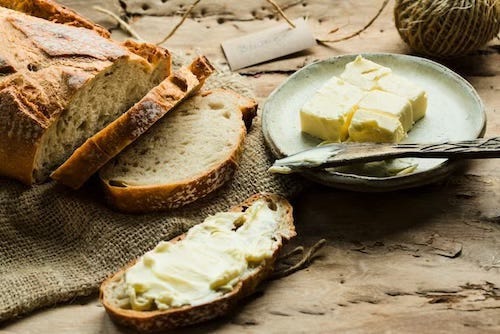
Bread landing buttered-side down is not just a metaphor for pessimism.
I was astonished and delighted to learn that people have done actual studies to see if this is really true, examining whether the weight of the butter has an effect, etc.
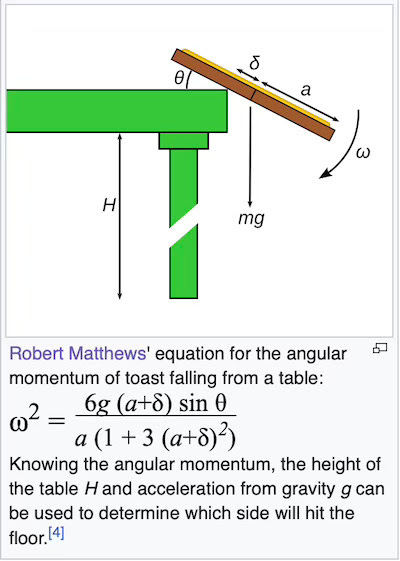
I was dazzled to learn that not only did Robert Matthews, an Oxford physicist, determine the calculation for which side would hit the floor based on the height of the table and the angular momentum, he also won an award for this work.
No, not the Nobel Prize in physics but the IG Nobel Prize (you’ll have to sound that out yourself), a satirical prize given every year by actual Nobel laureates in an awards ceremony at MIT.
There’s even prize money: a banknote for 10 trillion Zimbabwean dollars, currently worth about $0.40.
Behold Matthews’ prize-winning equation.
A Mary Oliver poem is always a good thing, but it can be deeply appreciated during times when you’re waiting for approval (whether from Amazon or the world).
This one in particular called out to me this week.
Wild Geese
You do not have to be good.
You do not have to walk on your knees
For a hundred miles through the desert, repenting.
You only have to let the soft animal of your body
love what it loves.
Tell me about despair, yours, and I will tell you mine.
Meanwhile the world goes on.
Meanwhile the sun and the clear pebbles of the rain
are moving across the landscapes,
over the prairies and the deep trees,
the mountains and the rivers.
Meanwhile the wild geese, high in the clean blue air,
are heading home again.
Whoever you are, no matter how lonely,
the world offers itself to your imagination,
calls to you like the wild geese, harsh and exciting —
over and over announcing your place
in the family of things.

It’s definitely related and may even go beyond the pain of waiting for approval, but in I Know Why the Caged Bird Sings, Maya Angelou wrote that:
“There is no greater agony
than bearing an untold story inside you.”
Having something to express and not being able to get it out there is its own kind of endless toothache, one that can be ignored but not without perpetual suffering (and worsening decay).
Before I forget, there’s still one spot left for coaching this season — whether for Creative Projects or Life Reinvention.
You can learn more HERE or simply reply to this email with “Transform” to start a conversation.
Don’t let your story go unheard, your dream unlived.

It took a 20-hour wait but the supportive Amazon supervisor wrote back to me saying that the tech team had resolved the issue, basically confirming that — despite having “Journal” in the title — indeed my new book is not blank.
That meant that even though all the previously entered info (ISBN number, metadata) stands, I still had to re-hit PUBLISH one more time… and wait again for approval.
(sigh)
After a two-hour drive, my dental visit was astonishingly brief.
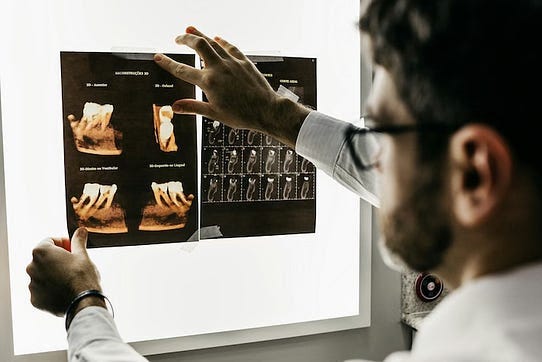
I was whisked into the chair almost immediately for a full set of X-rays.
Two minutes later, my new dentist appeared, poked around my mouth for five, maybe ten minutes, and told me I had no cavities.
My long-vanished pain…?
I have now learned that jaw tension can apparently masquerade as a toothache.
The same trigeminal nerve serves both the jaw muscles and the teeth, causing the brain to get fuzzy about the source of the pain.
Essentially, tight or overworked chewing muscles can create a deep, dull ache that feels dental but isn’t.
The phenomenon even has an almost poetic name: “referred pain,” felt but coming from a disguised source and — just like my Amazon case — caused by the brain’s mislabeling.
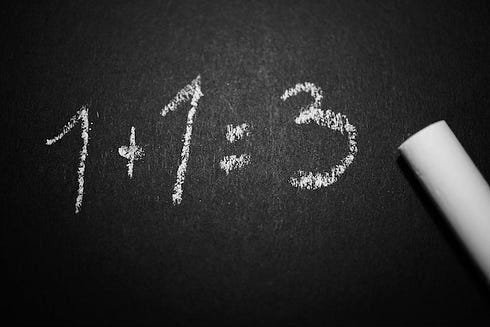
Appropriate to this month’s theme It’s All in the Timing, meditation HERE — the launch schedule has shifted.
Even so, this particular story won’t be untold for much longer.
Beyond all this, I’ve stored a four-hour drive’s worth of Russian proverbs from my audiobook.
My favorite by far — relating to making inner changes versus adjusting outer circumstances:
“If you want to trim your beard,
don’t shave the mirror.”
Being mislabeled as low content was indeed a moment of “referred pain.”
Sometimes the reflection takes a moment to catch up to reality, but if we’re patient, ultimately it does.
And, as my new dentist will testify regarding my cavity free mouth, sometimes the toast does indeed land butter-side up.
Tell A New Story | Transform Your Life