
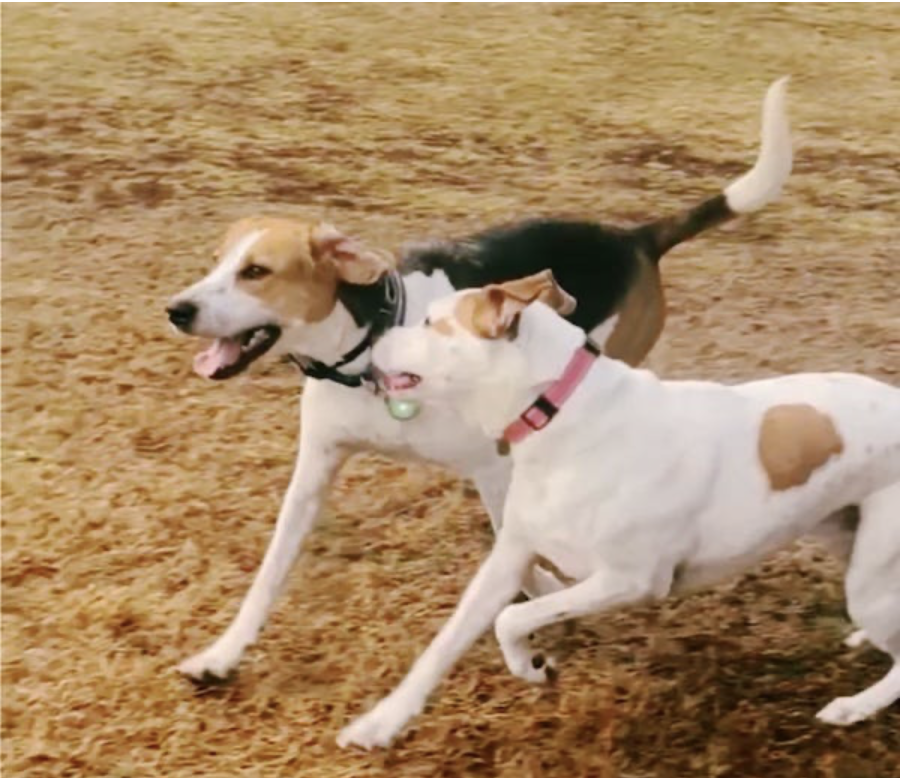
Mostly it was a viral video moment, overflowing with cuteness.
It’s only happened twice before with Zeus — a dead-ringer for Malibu, Vlad’s best friend from their NYC puppyhood.
Specifically, it’s on our morning walks through the woods adjoining the college campus that we rarely run into another off-leash dog.
Last Sunday was our second time encountering Quinn, who honestly looked like he could be a long-lost cousin of Vlad’s.
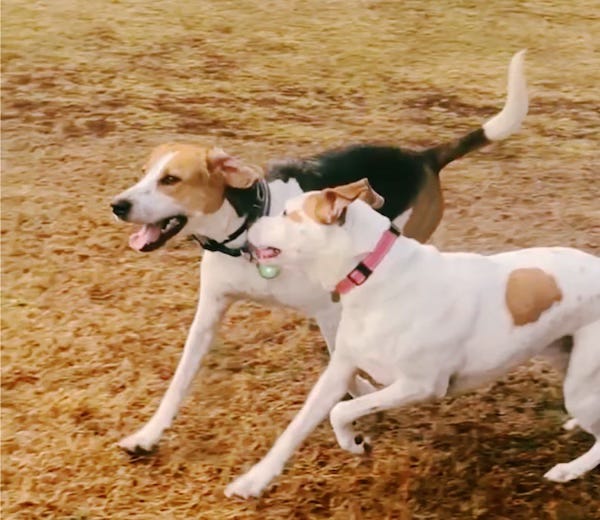
Their rapport was instant — AND energetic.
Both encounters, however, had an element of strangeness to them.
Don’t get me wrong.
Both Quinn and his owners could not have been more friendly.
What was odd was that — as though in a presidential motorcade — they stayed in their truck, creeping along at a snail’s pace as Quinn trotted alongside them, tracing the perimeter of the parking lot.
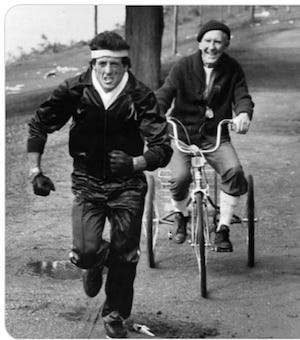
Although it immediately reminded me of a near-70-year-old Burgess Meredith training Rocky by biking alongside him, the owners’ situation and motivation were more mysterious.
As our dogs frolicked, we chatted about their shared DNA — we’d both done Embark testing, and they each have a lot of Treeing Walker Coonhound — before they shifted their truck into Park.
Having just finished the January Transformation Book Club Selection — The Body is Not An Apology by Sonya Renee Taylor; upgrade to join us HERE — I was doubly sensitive to making assumptions about their physical limitations.
There may very well be utterly unassailable reasons they could not walk alongside their dog, and it felt supremely rude to ask about their unusual drive-along ritual.
Still, not actually walking along while you’re taking your dog for a walk feels like only half the experience, or to quote T.S. Eliot in The Four Quartets:
We had the experience but missed the meaning.
Since I’m exploring the theme of Embodiment this month — meditation HERE — I’ve been deeply interested in what it means to truly feel something in the body.
For example, I shared a powerful 2016 study by Leah S. Redwine, MD, about gratitude in this week’s class.
(Sidebar: It’s hard to fault a study when the attribution given is Redwine et. al)
Her work demonstrated that gratitude journaling produced measurable physiological changes.
These included improved heart rate variability (a marker of nervous system resilience) and reduced inflammatory biomarkers.
Participants also reported better sleep and mood.
Rather than just being an airy-fairy mindset shift, we have actual scientific proof that gratitude affects biological regulation and physical readiness.
On an intuitive level, we may feel we already know this, but it’s still profound to realize gratitude is more than just an attitude; it’s reorganizing the body from the inside out.
Thus far, I’ve resisted the nostalgia trend on Instagram urging everyone to post about 2016.
I did look through photos from that year and what I was most struck by was how I was still teaching a few yoga classes each week and how much I gained from that.
In fact, last week I wrote about a post from 2016 where a delighted student first took flight in a balancing pose.
Indeed, the life lessons I’ve learned from teaching have been enormous, but in particular I was reminiscing about what it felt like to reconnect someone to their body, often for the very first time.
Particularly with private clients who often felt intimidated at the thought of entering a classroom full of super-flexible students who knew all the poses, there was surprising and heartfelt attunement to body awareness.
I’ve taught so many incredibly smart and successful individuals who might be able to map out a marketing plan or a corporate takeover in their head, but their sense of their own body was pretty much at the stick figure drawing level.
I mean no disrespect, and there’s obviously no direct correlation to intelligence here, for, as Goethe said:
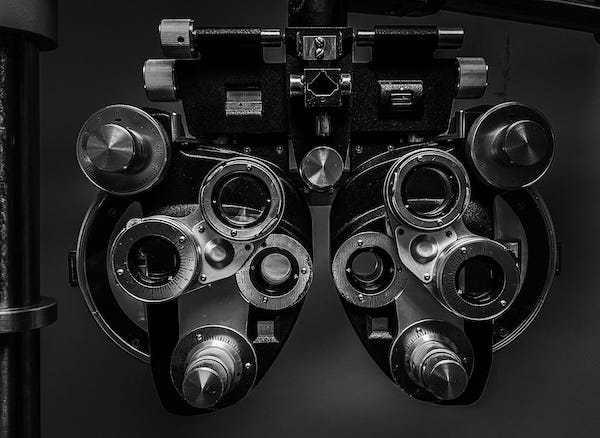
“The hardest thing to see is what is in front of your eyes.”
My own body awareness journey had several humble beginnings but none more so when I was getting a little smug.
This was probably way back in the early 2000s when I’d been teaching for several years and was generally pleased at my ability to take complicated instructions and morph into difficult poses in advanced classes.
Around that time I also saw a lot of dance.
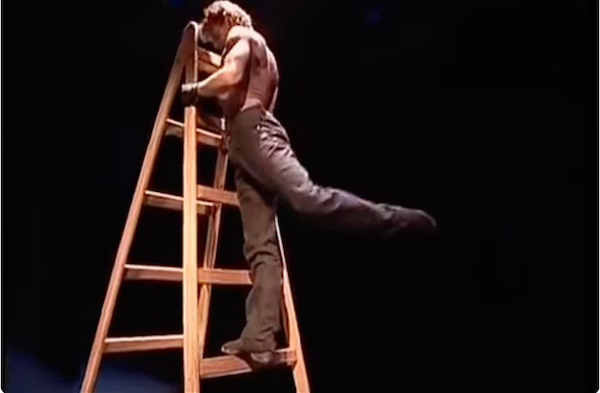
I was blown away by Bocca Tango, Julio Bocca’s late-career tango project, created after decades as a classical ballet superstar.
The piece blended Argentine tango vocabulary with Bocca’s classical ballet line, and one piece in particular stood out for me: Años de Soledad (“Years of Solitude”).
It begins with a lot of stage smoke and a ladder onstage.
Then Julio does this sort of tango with the ladder — but rather than tango as seduction it’s about memory, time, masculinity, and yes, solitude.
It reflects a deeper kind of body literacy — fluent, economical, and unselfconscious — especially poignant from a former virtuoso no longer interested in showing off technique, but as a man looking back and within.
You can watch it HERE and see if you agree.
Anyway, inspired by that — and by one of my all-time favorite albums, Daniel Barenboim’s Mi Buenos Aires Querido: Tango Music from Argentina on Spotify HERE — a friend and I enrolled in some tango classes.
And … I was a disaster.
Suddenly, I was the intimidated student who knew none of the poses, or in this case dance moves.
And worse, the instruction was visual not verbal.
Rather than what I was used to — precise anatomical direction like “Rotate your forearms inward and release your shoulder blades” — it was basically a quick “Simon Says” demo while sexy music blared.
It was truly humbling but in the best possible way.
As Sonya Renee Taylor reminds us:
Your body is not an apology.
It is your home in the world.
It deserves to be loved and respected in all its magnificence.
Even, I’d add, when tripping over yourself in a tango lesson.
I do hope we run into Quinn and his motorcade owners again soon.
Perhaps they’ll volunteer an explanation for why their dog runs alongside their truck while they remain inside.
It’s even possible we’ll meet on the actual trail, not just the edge of the parking lot.
For now, I’ll let them have their own experience — without questions.
It’s their physical journey, not mine.
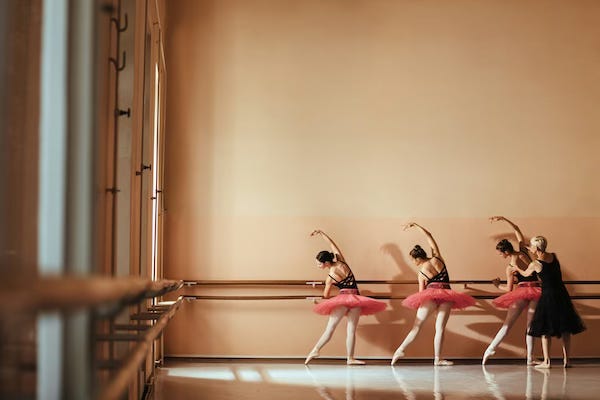
Body awareness can expand in many ways — through a stiff yoga student or an awkward tango lesson — and it speaks a language all its own.
As Martha Graham often claimed:
“The body says what words cannot.”
Sometimes — like with Vlad and Quinn — that language inspires you to run around like maniacs.
Other times, it leads you to tango with a ladder.
Or, like gratitude, it can surprise us by reaching deep into our cells and changing them forever.
Tell A New Story. Transform Your Life.