

Like most good ideas, it seems incredibly obvious … but only after it’s been perfectly executed.
Before then it’s easy to criticize, even attack.
This week, during one of my Harvard Business School Foundry program lectures, a noted venture capitalist — wearing the traditional fleece vest and needing to jump off promptly on the hour for another meeting — made this point abundantly clear.
The example he gave was a deal he’d been part of over a decade ago.
He even shared the presentation that gave them their first round of funding.
Specifically, for MasterClass.
You’ve probably heard of the subscription-based streaming service where celebrities, icons, and industry leaders ranging from Gordon Ramsay (Cooking) to Serena Williams (Tennis), Steve Martin (Comedy) to Christina Aguilera (Singing), and even Martin Scorsese (Filmmaking) share their expertise.
Many things were fascinating about the company’s early challenges, but a few things really stood out for me.
Most particularly, the reasoning behind not just how they chose their first instructors but, more importantly, what fields they came from in order to impress their future investors.
The answer was acting — but not for the reasons you’d suspect.

Earlier in the day, I recalled a similar project of my own from right after college, one I rarely think of since it seems almost from another lifetime.
Always intrigued with the creative process, I’d sold a proposal for a book about acting methods.
That project took many turns — and three different publishing houses and editors — but it finally evolved into a book of interviews I’m still quite proud of that Rutgers University Press released.
I thought of it during a meeting with an actor that morning who shared he wanted to write a book about his own quirky methodology but was having trouble completing it.
None of this intersects with the reason that MasterClass wanted one of its first offerings to focus on acting.
The clever calculation behind that was something I would never have imagined.

The MasterClass founders decided to determine the educational area where:
a) people were willing to consistently pay the most money yet
b) the teachers had the least impressive credentials.
The clear “winner”: acting classes.
Please believe me: I mean no diss to acting teachers.
In fact, for my book’s research I attended the last set of master classes with the legendary Stella Adler, teacher of Marlon Brando and De Niro.
She was truly inspirational and brilliant.
Yet so many of the supremely talented actors I know have indeed been willing to shell out a ton of cash for programs taught by people with the most minor, sometimes even non-existent credits.
Proving that absolutely anyone can hang out a shingle, that’s exactly what happens with Jack in Season 5 of Will & Grace.
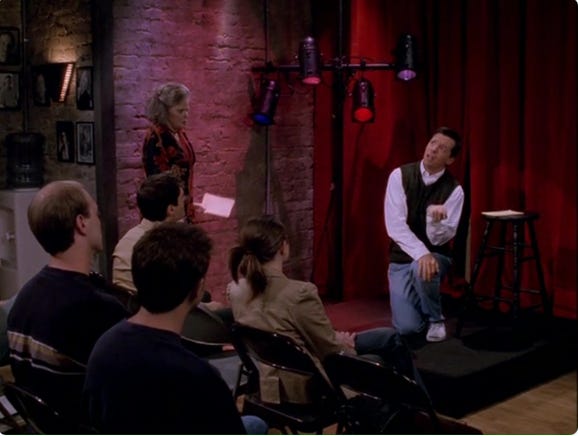
After his terrifying teacher Zandra (played by Eileen Brennan) tells him he’s terrible, Jack (Sean Hayes) snaps back that it must be her fault.
In retaliation, she makes him teach her class for the day.
Jack almost instantly invents The McFarland Method.
His “method” is, of course, beyond absurd.
In fact, it is almost entirely focused on personal appearance.
He tells one student not to cry during a heartbreaking anti-smoking PSA about a child whose grandfather died of cancer because crying makes her look ugly.
Jack also tells a handsome student to take off his shirt randomly, and remarks that while Ophelia may be suicidal, she’s still a pretty girl — so why isn’t she wearing a bikini?
The ridiculous thing is that, astonishingly, Jack’s “method” actually sorta works.
One student lands a toothpaste commercial, and after he abandons the class, another student takes over and starts formalizing the McFarland Method.
In contrast to this absurdity, MasterClass set its bar for an instructor a little higher.
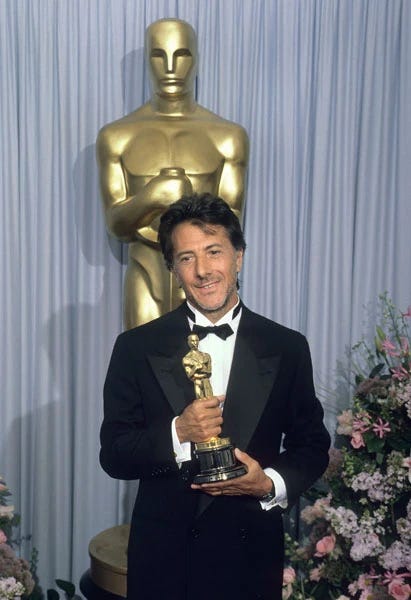
They wanted someone with two Oscars, multiple BAFTAs and Golden Globes, an Emmy, a Tony nomination and the Kennedy Center Honors.
They wanted someone like Dustin Hoffman.
On the most simplistic level, I’ve always found the clichéd advice to fake-it-till-you-make-it supremely annoying.
Even so, the theme I’ve been exploring this month — Connecting With Your Future Self, meditation HERE — dovetails perfectly with acting.
On the deepest level, we are — or we become — what we repeatedly do.
For example, why is someone a writer?
I’ve often quoted those lines by Antonio Machado:
Traveler, your footprints are the path, and nothing else.
Traveler, there is no path. A path is made by walking.
An actor seeks to become a character created in a text.
Connecting to your future self allows you to do the same, with a script that only you can write.
Meditation again HERE.

Having convinced potential investors of their logic, the founders still had to secure Dustin Hoffman’s participation for their launch, and then secure their other master teachers as well.
I was very much reminded of my own experience with the acting book interviews.
Essentially, I had to create a domino phenomenon: once I had one significant person onboard, each subsequent interview became easier to secure.
I’m reminded of how in His Way, the 2011 HBO documentary about Jerry Weintraub, Matt Damon, Brad Pitt, and George Clooney recounted stories about the casting of Ocean’s Eleven.
Weintraub would call up one actor after the other, inflating the involvement of each until miraculously everyone was secured.
In a similar way, the MasterClass founders leveraged all their connections so that when they launched, their first three teachers were indeed Hoffman, Serena Williams, and James Patterson.
The rest is history.

Unlike Jack McFarland, I do not have a method, but I have successfully coached many creatives on their projects.
(There’s lots of info and testimonials about that HERE.)
Interestingly, since I had succeeded on an often very rocky road of getting published and produced, I felt authentically qualified for that.
In the last decade, however, coaching people for life reinvention — offering support and helping them figure out next steps — happened unexpectedly but organically as well.
It was a natural coaching bridge, since any valuable insights were not at all theoretical, but were garnered from real-life experience.
(In other words, think “phoenix rising from the ashes” moments.)
If you’d like to have a free conversation about either possibility, reach out HERE.

One final insight from that venture capitalist, again right before he took off for another meeting.
To encourage the community of aspiring entrepreneurs, he repeated a reminder several times that it was often truly “always darkest before dawn.”
Many of the most successful businesses his firm has backed were quite literally about to close their doors before everything suddenly turned around.
Far more important than “fake it till you make it” is the wisdom to keep embodying it until you are it.
Connecting with your future self is a profoundly honest way to travel that path.
Whether you’re a student of Jack McFarland or Dustin Hoffman, I think there’s great comfort there.
Tell A New Story. Transform Your Life.