

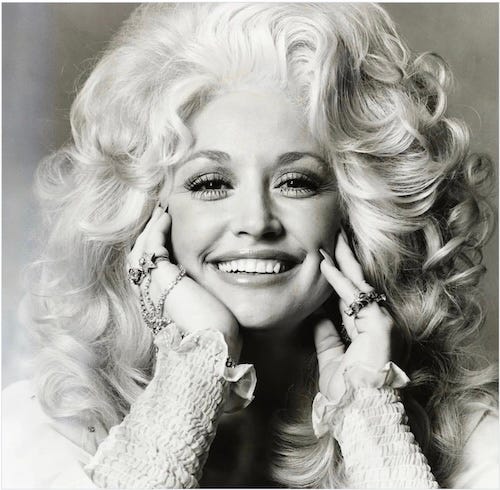
Like pretty much everyone, Dolly Parton’s passing touched me in ways I hadn’t anticipated.
Unique and utterly irreplaceable, she unsurprisingly topped a recent national favorability poll, scoring more than 50 points higher than every politician and pop star surveyed.
Story after story focuses on her kindness, generosity, and open-heartedness.
There’s so much there to appreciate and emulate.
I also took particular inspiration from the astonishing fact that, in 1973, one masterpiece arrived hard on the heels of another.
More on that in a moment.
This week I took a break from the increasingly complicated — some might say tangled — screenplay I’m writing for an independent producer, turning my attention to a new story idea that had just come to me.
The new one is a complete U-turn from the other in every way.
As a storytelling exercise, I shared the plot with some writer friends, and doing so was not only effortless but also pleasurable.
The narrative is full of drive and momentum, prompting comments like “I can totally see it.”
It was almost … dare I say it … too easy.
There’s often a temptation to mistrust something important that comes so swiftly, but that wasn’t the case for me.
Inspired by Frances Marion, this was exactly the process I wanted to emulate.

I recently shared (HERE) that Frances Marion was the world’s highest-paid screenwriter, male or female, for almost three decades.
During her career, she wrote the screenplays for nearly 200 produced films.
Granted, some were silent films and shorter than today’s features, but still … that’s amazing.
In contrast, I rewatched a documentary short about an Oscar-winning screenwriter I very much admire.
In it, he talks about researching a project for a year.
Then comes a year or two of writing, beginning with literally hundreds of index cards that map out every possible permutation of the script.
That amounts to one written script every two or three years — and mind you, that’s written, never mind produced.
The process might be fascinating for that writer, but for me that would be pure torture.
In fact, it reminds me of an anecdote from the set of Marathon Man.
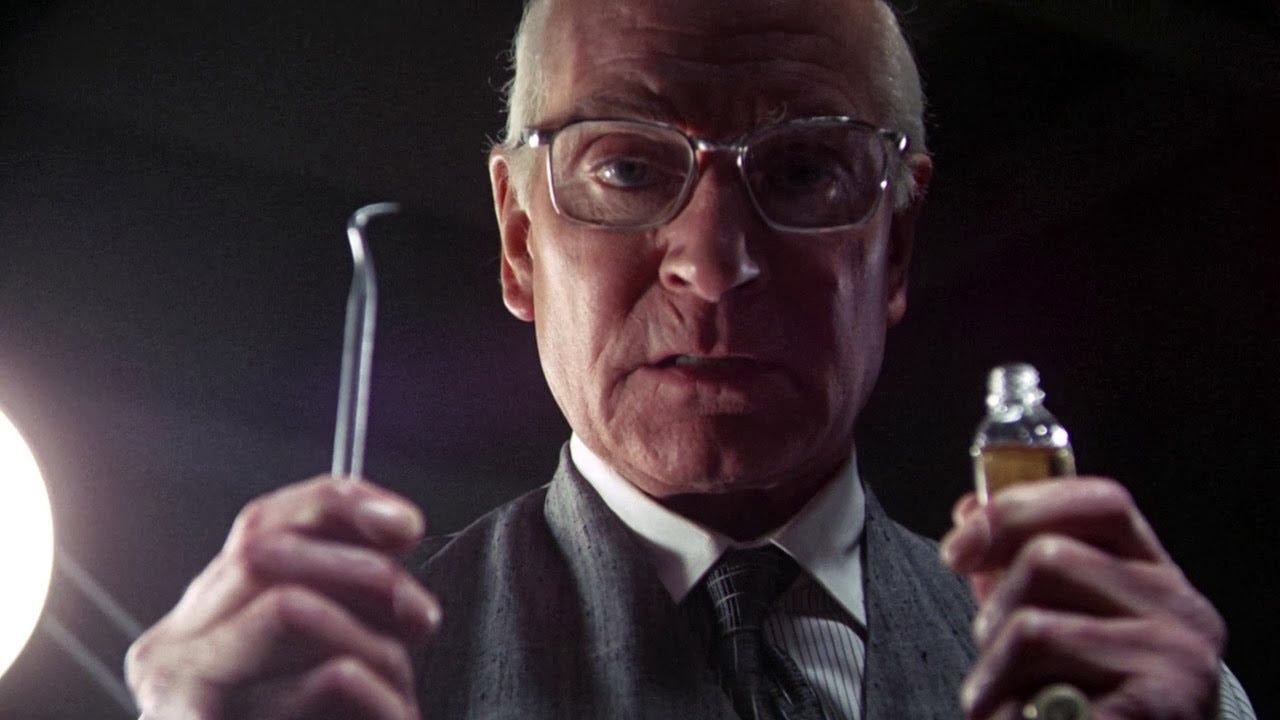
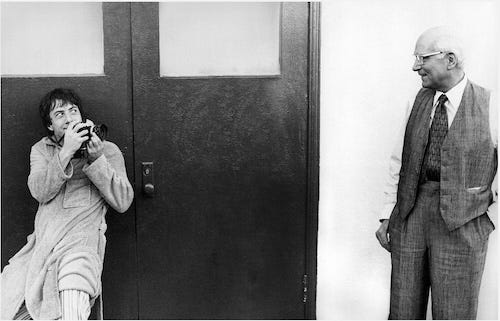
According to Hollywood legend, while filming the 1976 movie Marathon Man, Dustin Hoffman — a truly dedicated method actor — stayed awake for 72 hours so that he could look genuinely exhausted.
In the usual telling, Olivier took one look at Hoffman’s authentically wrecked state and quipped:
“My dear boy, why don’t you just try acting?”

In her 2020 collection of lyrics, Dolly Parton, Songteller: My Life in Lyrics, Dolly revealed that she may have written two of her biggest hits on the same night.
“When we were going through all my old tapes to put my songs on hard drives, we found that ‘I Will Always Love You’ and ‘Jolene’ were on the same cassette tape, back-to-back. I don’t know; I might have written ‘Jolene’ later that night… Otherwise, I would have gone onto another cassette, or there would have been other things on it. It very well could have been on the same day.”
Granted, it was nearly 50 years earlier, but it’s amusing that she couldn’t recall the specifics of creating two masterpieces.
The larger truth is that profound creation — or profound personal change — can happen very quickly.
Quick does not necessarily mean shallow or unearned.
Ease may be the visible result of inspiration, but I think more often than not, it’s mastery.
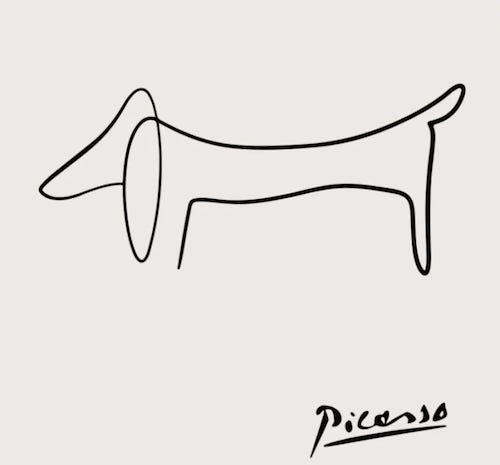
There’s a story about Picasso that’s probably apocryphal but nonetheless worth telling.
As the story is usually told, Picasso is sitting in a café when a woman recognizes him.
She asks him to make a quick drawing for her.
Agreeing, he produces a sketch on a napkin in only a few seconds.
Then he names an enormous price — sometimes said to be $100,000.
The woman protests: “But that took less than a minute!”
Picasso replies:
“No. It took me forty years to do that in thirty seconds.”

In all of these examples — Dolly, Frances, and Picasso — a lifetime of practice helps explain how each could create masterpieces so quickly.
I think what’s interesting here is that a profound personal insight or powerful decision can also occur quite quickly.
Yet that newsflash of insight that isn’t enough.
The challenge lies on the other side: repetition, rehearsal, and living from the new understanding until it becomes familiar, until it feels normal.
And that’s what I’m doing — and offering — this September.

Two and a half years ago, I created a course I loved, Tell A New Story: The Power of Reinvention.
I have a folder full of emails from people sharing the positive impact the course had on their lives.
Earlier this month, I was vividly reminded of that course during my first Harvard Business School Foundry lecture, when the professor used the Hero’s Journey — the framework at the heart of my original course — specifically for entrepreneurship.
It occurs to me that now is the right time to revisit Tell A New Story and bring it to its natural next level, one focused on practice.
That’s why I’ve created a live four-class experience designed to help you stabilize, deepen, and apply the work using updated, neuroscience-backed techniques.
Breakthroughs can be instantaneous, but making them last requires practice.
The old story feels natural mostly because the brain has rehearsed it thousands of times.
Familiarity loves to masquerade as truth.
A new story requires practice.
Learn more — and enjoy Early Bird pricing through September 9 — with this link.
There’s an interesting footnote that reframes that anecdote about Dustin Hoffman and Laurence Olivier.
Hoffman later explained that Olivier’s comment wasn’t really a critique of his method acting.
He was going through a painful divorce and had spent the previous nights drinking and partying hard.
Instead, Olivier’s famous response was a knowing, sympathetic comment on Hoffman’s personal choices.
Perhaps it was even an edgy invitation to reinvent.
Finally, it’s worth remembering that Dolly’s I Will Always Love You was itself an act of reinvention.
She wrote it after her repeated attempts to tell her longtime professional partner, Porter Wagoner, that she was leaving had failed.
Dolly needed to find a way to tell the story of their separation not as one of betrayal, bitterness, or abandonment but as one of love, gratitude, and the freedom to move forward.
It’s a master class in the power of Telling A New Story — and in realizing that it’s never about one magical insight.
Practice is the hidden bridge that connects everything.
It’s about what comes after that: taking each step with generosity and kindness … just like Dolly.