

The first temptation — to simply “wing it” — was easily fought off.
Interestingly, that phrase, I’ve since learned, comes from 19th-century theater actors who, not having enough time to learn their lines, would hover near the corner of the stage (“the wings”), ready to receive prompts from the script.
Although Vlad did make an on-camera appearance at the beginning of my Zoom talk this week, he really wasn’t that interested in cueing talking points.
More importantly, since the group to whom I was speaking included a Pulitzer Prize–winning journalist, New York Times bestselling authors, and writers whose books have shaped conversations about science, psychology, politics, and culture, some preparation seemed in order.
The second temptation, however, involved a much harder negotiation — one requiring an abundance of Discernment— this month’s theme; meditation HERE.
Specifically, crafting a 45-minute presentation about getting oneself unstuck — reinvention, in other words — for this prestigious group meant selecting from more than a decade of anecdotes and insights drawn from coaching experience.
It required editing decisions I can only regard as ruthless.
Like all good detective work, the central premise is elimination.

I was delighted to find this theme echoed as I binge-watched Young Sherlock on Amazon Prime.
Interestingly, the Guy Ritchie production gives one of Sir Arthur Conan Doyle’s most famous lines not to Holmes, but to his new friend — and future arch-nemesis — James Moriarty:
“When you have eliminated the impossible,
whatever remains, however improbable, must be the truth.”
Although this principle is not always strictly adhered to, the simplicity it advocates is admirable.
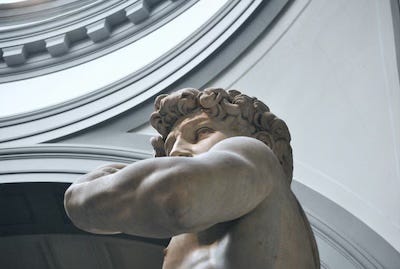
Speaking of reduction, I’m reminded of Michelangelo’s most famous quote regarding his sculpting process:
“I saw the angel in the marble and carved until I set him free”
The sculpture already exists within the stone and the artist’s role is simply to remove the excess material to reveal it.
For both the sculptor and the detective, eliminating the superfluous is the best — perhaps the only — method to uncover the truth.
The New York Times Games section seems committed to taking up more and more of my day.
After the Covid-era success of Wordle, they’ve added a new puzzle every year.
In 2023, they introduced Connections; in 2024, Strands.
And in late 2025, they unveiled Pips.
When I first attempted it, Pips confounded me — until I finally learned how to solve it quickly.
My initial approach was to look at the dominoes and ask:
What could be true?
That was entirely the wrong question, pretty much guaranteeing that you will spin around in circles, exhausting yourself in possibilities.
Instead, I realized that the way to solve it swiftly was to ask two different but overlapping questions:
What must be true?
What cannot be true?
Once you switch questions, the puzzle can reveal itself.
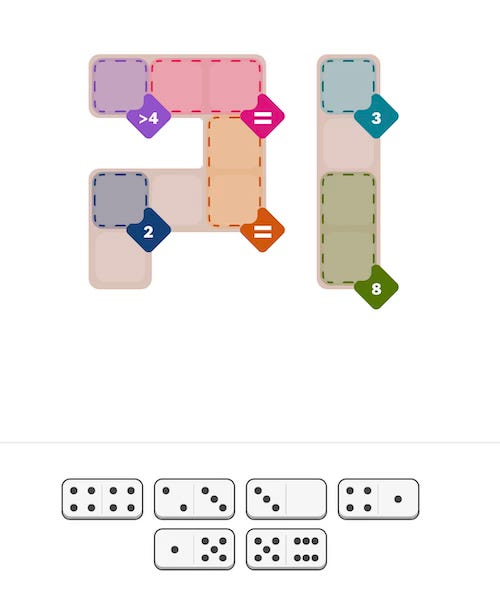
Today’s Pip’s puzzle … Impossible … unless you’re asking the right questions.
In a similar way, as I outlined my talk to the writers’ group, I could not help but remember a phrase often attributed to William Faulkner, but really from a 1914 lecture by Arthur Quiller-Couch.
“Whenever you feel an impulse to perpetrate a piece of exceptionally fine writing, obey it — wholeheartedly — and delete it before sending your manuscript to press.
Murder your darlings.”
This famous piece of advice insists that you must be willing to cut even the parts you love most if they don’t serve the piece.
You may adore a line.
But the work itself may not need it.
That’s where discernment enters: choosing the integrity of the piece over the pleasure of the moment.
Just like solving the Pips puzzle, the decision-making process becomes simple:
What must stay?
What cannot stay?
Throughout this editing process, it is essential to remember that cruelty is obviously never the goal.
Clarity is.
Interestingly, many writers delight in the process’s secret loophole:
You can always save a line and use it somewhere else.
Your darling is not really murdered but moved.
Literary superstars have practiced this for generations.
At Ezra Pound’s suggestion, T.S. Eliot cut nearly half of The Waste Land, incorporating parts of it into later poems and writings.
Eliot even dedicated the poem to Pound, dubbing him “the better craftsman.”
Both William Faulkner and F. Scott Fitzgerald frequently expanded short stories into novels, moving not only lines but also entire scenes between works if they did not yet have the right home.
Recycling may have become a modern cultural movement in the 1970s, but writers have been doing that with words forever.

Speaking of which …
Midway through my preparations for the talk, I realized that what I was outlining — this guide for getting unstuck creatively — was actually the perfect skeleton for a new short course, Five Steps to Rapid Reinvention.
Favorite stories I had to cut for economy when presenting live on Zoom could now find a home elsewhere.
Valuable exercises there wasn’t time to include in a speech, now can live and breathe and work their magic.
Even so, I’m sure that as I shape the five short modules further, I will still need to edit — still need to kill a few darlings — since the battle for clarity is never-ending.
If you’re curious about reinvention, about getting unstuck and figuring out what’s next — and you’d like to reserve the course for $47 instead of $97 when it launches next month — you can:

Although science has proven again and again that the universe is expanding, paradoxically perhaps the only way to live within it is through subtraction.
We may never be able to fully solve life’s mysteries, but it’s clear that the process of revealing the angel in the stoneis through elimination.
Like Holmes and Moriarty casting out the impossible, or writers tucking away their best lines in a drawer, we must use Discernment to reach the heart of the matter.
The only way to efficiently solve the logic problems in Pips — or life — is by continually asking ourselves:
What must be true?
What cannot be true?
And then having the courage to act on our findings.
Tell A New Story. Transform Your Life.