

I’m not sure where it came up with the name, but I went with it nonetheless.
Only afterwards did I ask why it had made that particular choice.
(The theme again this month is Discernment — meditation HERE).
The ChatGPT response was that “Orion” was:
- memorable
- specific
- neutral
- and clearly user-provided information.
The phrase in question:
“My dog’s name is Orion.”

I’m talking about the sentence that ChatGPT gave me to test the new AI interface for my book, The Science of Getting Rich Journal.
Specifically, we upgraded this week so that — rather than just answering each question individually — it now has conversational memory.
This means that the AI remembers what you tell it during a conversation — such as “my dog’s name is Orion” — but when the conversation ends, the memory disappears.
I tested that — after rounds of ever-deepening questions — when I’d later ask “What’s my dog’s name?” I’d get the right answer: Orion.
Opening up another window, the memory was gone.
All of this was doubly compelling given that I was simultaneously reading this week’s New York Times story entitled “Super-Agers’ Brains Have a Special Ability,” which explains why — like my AI — they have such exceptional memory.
Before we get to that, I want to share something else that happened this week.
On Sunday night, I braved another hot yoga class with the teacher whose bio accurately describes her as “very detail-oriented” and obsessed with “the body’s micro-movements.”
(In other words, the ones where I feel completely dissected and convinced I’m doing nothing correctly).
I was braced for the heat and the criticism, but not for what happened mid-class.
Walking to the back of the room to adjust the heat back up to 106°, the instructor noticed that something unusual was happening just outside the studio in the parking lot.
Recognizing a student’s truck, she interrupted the flow to ask him if there was some reason somebody was going through his glove compartment.
Sweaty and confused, he left the class for the 35°F (2 °C) parking lot, never to return.
Apparently, overly confident in the center’s discreet location in an affluent Connecticut suburb behind other street-facing shops, he had left his vehicle unlocked and his wallet exposed.
I’m not trying to blame the victim, but on the other hand, this is what happens when you lack Discernment.

The New York Times article presented a “Young Neurons” paradox.
A new study offered this surprising finding:
Super-agers had more immature neurons than even young adults.
This meant that it wasn’t just that they had well-preserved brains.
They had ones that were actively renewing themselves.
At first this might seem truly counterintuitive, since we mostly conceive of successful aging as maintenance — of, unlike the sweaty truck owner, simply holding on to what you have.
This research, however, suggests the opposite.
The healthiest brains are the ones that keep creating new pathways, new ways of seeing.
Discernment’s great gift to memory is NOT:
• protecting old beliefs
• defending past stories
• clinging to familiar interpretations
Instead, it’s the ability to generate new meaning, to tell new stories.
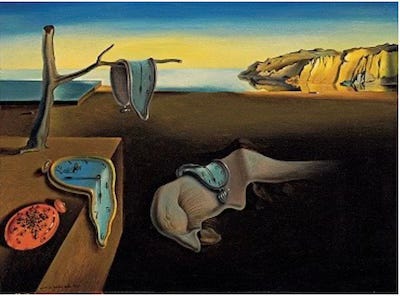
Especially given my god-like powers to design it for my website, I was reminded of The Persistence of Memory by Salvador Dalí.
Painted in 1931, MoMA’s surrealist masterpiece — at 9.5 × 13 inches — is remarkably small given its unforgettable imagery.
The melting clocks are usually interpreted as representing the fluid nature of time, underscoring the difference between its mechanical and psychological realities.
Time dissolves in dreams, memory distorts reality, and the mind reshapes our experiences.
In some ways, this echoes the study’s finding that exceptional memory may depend on the brain’s ability to generate new neurons in the hippocampus, constantly renewing the machinery of memory.
In other words, memory persists not because it is fixed, but because the brain keeps rebuilding it.
Dalí shows time melting; neuroscience shows memory renewing itself.
Fundamentally, it’s the same idea:
Memory is not a rigid archive, a library where we retrieve data.
Instead, it is something very much alive and ever-changing, and therefore completely affected by Discernment.
Another fascinating detail of the study was about Alzheimer’s and what amounts to “Stalled Potential.”
Research found that people with Alzheimer’s had:
• more neural stem cells
• but fewer developed neurons
That means that their brains had potential but couldn’t complete the transformation.
For reasons still to be discovered, the process stalled.
In a way, this can be seen as a powerful metaphor for modern life.
We live in a world of:
• endless information
• endless ideas
• endless inspiration
But many of those ideas never mature into real understanding.
Discernment is required; otherwise ideas remain raw material, unable to connect in ways that produce shared meaning.

At the complete other end of the spectrum, I thought about the Akashic Records.
For some of you, this will be — quite literally — the oldest of news.
In ancient Egypt, Thoth’s role was to record the deeds of the dead so their hearts could be weighed against the feather of Ma’at.
In the Bible, the Book of Daniel and later Jewish traditions describe books opened at judgment.
In the Islamic tradition, the angels also record human actions in a divine ledger, the Kiraman Katibin.
And in the late 19th century, Theosophy combined the ancient Indian concept of akasha (cosmic ether) with the Western idea of divine record-keeping to formulate a new version of this concept:
The Akashic Records:
a universal energetic archive of every event in time.
Historically, the Theosophists lived when several inventions had just appeared that radically changed how people thought about memory:
- Photography (images permanently captured on plates)
- The phonograph invented by Thomas Edison in 1877 (sound recorded that could be replayed)
For the first time in history, humans could record reality itself, capturing voices and images.
It’s wild to imagine how magical this must have felt.
The Theosophists essentially imagined something remarkably similar to a cosmic database — long before computers existed.
Like AI, it’s essentially perfect, potentially unlimited storage — and ironically, perhaps that’s its greatest limitation.
Speaking of which …

The hot yoga–going truck owner used two data points — fancy neighborhood + discreet location — and came to exactly the wrong conclusion: that it was safe to leave his vehicle unlocked with the wallet on the dashboard.
That’s entirely a failure of Discernment.
Despite the unhappy result, this underscores the fundamental truth that human wisdom is based on the choices we make.
AI remembers everything.
People interpret.
Wisdom is not about data storage.
It’s about selection, and Discernment is the intelligence of that ecosystem.
Like Dalí’s melting clocks, science suggests that the sharpest minds in old age may not be the ones that remember the most, but the ones that continue to embody new ways of seeing.
Indeed, anyone can program “My dog’s name is Orion” to test a memory that lasts across a conversation — but the beauty and wisdom of that interaction — what’s truly worth preserving — are entirely up to you.
Tell A New Story. Transform Your Life.