

It seems like the perfect metaphor for the past year (or at least my year).
Last night, in the middle of a full-blown snowstorm, our drive home from a holiday gathering not only took twice as long, but also included one wildly swerving moment on the ice.
Given that we awoke to seven inches of snow, my morning walk with Vlad was a mix of Winter Wonderland frolic and arctic trudge.
Our end-of-day walk, however, was a different story.
As I traveled the exact same path, it was easy to follow my own footprints.
That is, until the tracks suddenly stopped, covered by an entirely new fifteen-foot mountain of snow.
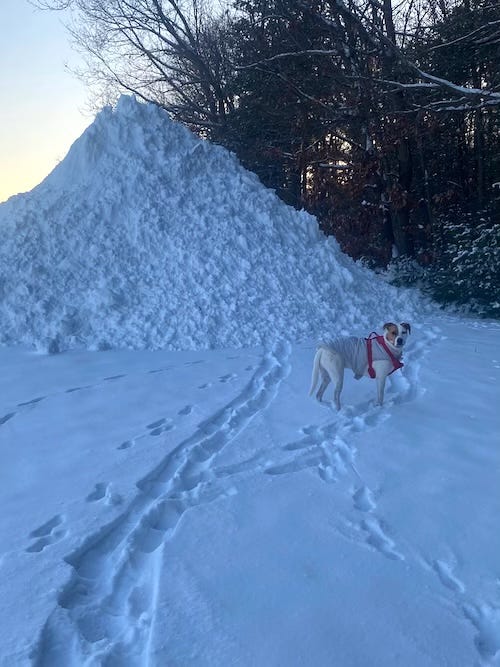
Our morning walk through a mini-forest is adjacent to a local community college parking lot.
The snowplows had spent the late morning and early afternoon clearing the way for Monday’s students and faculty, dumping the snow into huge mounds.
This one was inconveniently placed directly on our usual path to enter the woods.
Fortunately, it was easy enough to lift a branch and limbo our way underneath.
Granted, this was a minor inconvenience, but nonetheless it felt symbolic of a year in which so many well-trod pathways were suddenly obstructed by unforeseen obstacles, ranging from bureaucratic snags to acts of God.

Speaking of re-traveling a path …
Although I’ve long owned it in paperback and also purchased the Kindle version of Natalie Goldberg’s Writing Down the Bones, a friend in my Transformation Book Club alerted me that the audio version was quite fascinating.
I’ve been listening to it all week and thoroughly agree.
Natalie Goldberg wrote this classic text about the power of writing as an actual spiritual practice — a book that dissolves the line between writing and living — when she was 36.
Fourteen years later, when she was around 59 years old, she recorded the audiobook in a unique format.
Natalie Goldberg reads all the original text as written, then adds new commentary to each chapter.
Sometimes she’s delighted to remember something she hadn’t thought about in years; other times, she finds her position has shifted a little (or a lot).
Some material she notes as quite dated — people were still using typewriters back in 1986, for example — while other sections reflect universal spiritual principles and life wisdom she shares to this day.
The layering is fascinating, allowing us to see what sometimes seems like — although they share the same physical and artistic DNA — two different people.

Here’s another kind of mini-mountain that appeared on my path.
When my last books were released, publishers strongly encouraged you to ask for honest Amazon reviews to activate the all-powerful algorithms.
The same is even more true now, except it’s become much more difficult.
It used to be that reviews would usually appear almost instantly after submission.
Now, reviews hover in limbo, often for three or four days.
Everything is now screened by an automated system — and sometimes human moderation — before anything appears.
Years ago, the system was lighter, faster, and more trust-based.
Now it’s more of a slug through wet snow, with plenty of pauses on the way.

Earlier this fall, I was struck by this synchronicity.
Quite poetically, the same Sunday morning when I shared a Pema Chödrön quote in this newsletter, Facebook reminded me that I’d posted it 15 years ago to the day.
In her book When Things Fall Apart, she reminds us that
“Nothing ever goes away
until it has taught us what we need to know.”
The flip side of this, of course, is managing our own behavior.
While Einstein never actually said “The definition of insanity is doing the same thing over and over again and expecting different results,” it’s telling that we attribute the quote to him.
It’s an insight that’s both brilliant and basic, obviously true yet dazzlingly difficult to practice.
And it reminds me of a favorite joke…

Six years ago, I wrote this about an annual Groundhog Day Workshop I taught.
I revealed nothing beyond its quirky title, but somehow every year it sold out.
I started the workshop with a joke.
Then I taught a yoga flow that was twenty minutes long, ending with drawing the blinds for final rest.
Everyone was very confused that I was seemingly ending the two-hour workshop an hour and forty minutes early.
Minutes later, I restarted the class with the same joke, teaching a forty-minute version, once again ending in Savasana.
Finally, opening with my same joke, I taught the class a third and final time for a more elaborate sixty-minute flow, ending it again in Corpse Pose.
And then I told the joke one last time.
Here’s the joke:
(And I promise I’ll only tell it once).

A group of construction workers has lunch together every day.
And every single day Sal, the burliest one, opens his brown paper bag, shakes his head and mutters:
“Damn. Ham on rye, again.”
This goes on for quite a while, day after day, always the same:
“Damn. Ham on rye, again!”
…until one day someone on the crew finally pipes up and asks:
“Sal, if you hate ham on rye so much, why don’t you just ask your wife to pack you something else?”
Sal is dumbfounded.
It takes him a full minute, but then he responds:
“What wife?… I pack my own lunch.”

Natalie Goldberg wrote Writing Down the Bones at 36, recorded the audio in her late 50s, and on January 4th, she turns 78.
I’d love to hear what the nearly eighty-year-old Natalie thinks about those earlier incarnations of herself.
An audiobook commentary on the audiobook commentary would be epic.
I’d be eager to ask which of her beliefs have been strengthened and which have been totally transformed.
I’m sure what she has to say now would be even more fascinating.
If this type of inquiry appeals to you, if you relish looking backward in order to move forward, you’re invited to join me for a free January 1st reset:
Together, we’ll look at the year that’s passed and plan the year ahead.
Most importantly, we’ll explore what new mountains have appeared on the path — whether they are Amazon’s shifting algorithms or our very persistent denial that, ultimately, we are all packing our own lunch.
Tell A New Story I Transform Your Life.