
They say a picture is worth a thousand words.
If that’s true, how much is a box of pictures worth, especially if they’re irreplaceable?
A friend of mine found that out this week and I had the pleasure of watching it unfold in real time.
Patricia Scanlon and I have been friends forever.
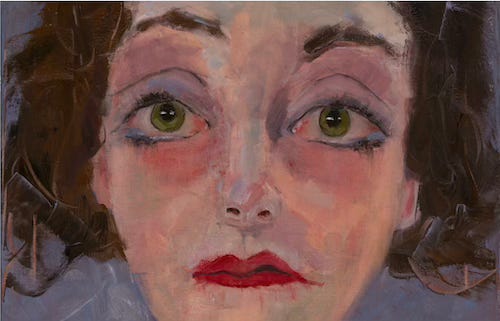
She’s an amazing actress — I’ve actually written several roles for her — and now a brilliant visual artistas well.
(That’s one of her paintings above)
Last Sunday, December 7th, Patty went to the Pasadena Flea Market.
Rummaging through a box of old photos, she found a black-and-white photo of a woman thinking to herself, “Ooh that’s the kind of face I like to paint.”
Purchasing the box for $20, she looked more closely at the woman and paused, wondering…
“I think I know her..???”
And that’s when the story gets really interesting.
The theme I’m exploring this month — meditation HERE — in tandem with the January soft launch of The Science of Getting Rich Journal, is Write It Down.
Perhaps the most important related research project is The Nun Study, led by Dr. David Snowdon.
Researchers followed 678 Catholic nuns from the School Sisters of Notre Dame, tracking their cognitive health as they aged.
Interestingly, the sisters were an ideal study group because they shared similar lifestyles, education access, healthcare, housing, and diets — allowing for an extraordinarily coherent control group.
The study’s most famous finding was derived from the autobiographical essays the nuns had written in their early 20s, decades before the study began.
In brief, it shows that the sisters whose early writings showed higher idea density were far less likely to develop Alzheimer’s disease or severe cognitive decline later in life.
Those with simpler, less detailed writing, on the other hand, were much more likely to exhibit cognitive impairment as they aged.
The study suggested that how we organize and express thought in language early in life may help build long-term cognitive reserve — not just what we know, but how we make meaning.
It’s worth noting that the researchers didn’t prove whether the writing itself protected their minds, or whether it was a barometer of strengths that were already there.
Most likely, it’s a combination of both.
What it does show, however, is that how we organize thought in language matters more than we once realized, and that meaning-making of the past has more than transitory benefits.
Memory, in other words, helps us endure.
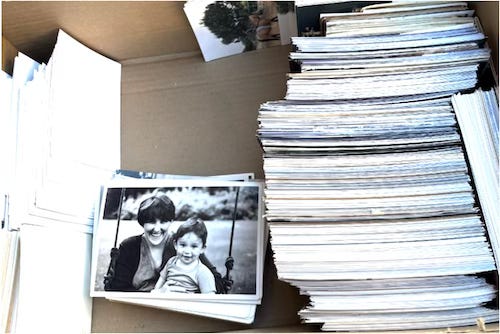
Back to that box of mystery flea market photos ↑…
Looking through more and more of the pictures she’d purchased, Patty suddenly realized who the woman was: Ricki Lake, star of Hairspray and other John Waters films, and — from 1993 through 2004 — iconic talk show host.
A letter in the back of the box, on Ms. Lake’s stationery, then confirmed Patty’s visual deduction.
Quick research showed that Ricki Lake had lost her Malibu home and everything in it during the Los Angeles wildfires last January.
Patty reached out to her friends (like me) on Instagram and Facebook to see if anyone knew a way to reach Ricki Lake directly.
Miraculously, within a day, through the power of Instagram Outreach, a connection was made.
Alfred Korzybski was a Polish-American philosopher and engineer who was interested in how confusing words with reality can lead to many problems.
His most famous quote is:
The Map Is Not The Territory
This same distinction can be made for recordings of experience — whether in written journaling or collected photographs — versus life itself.
In the same way, I’m reminded of the great Elizabeth Bishop’s wise and whimsical poem, The Map:
The Map
Land lies in water; it is shadowed green.
Shadows, or are they shallows, at its edges
showing the line of long sea-weeded ledges
where weeds hang to the simple blue from green.
Or does the land lean down to lift the sea from under,
drawing it unperturbed around itself?
Along the fine tan sandy shelf
is the land tugging at the sea from under?
The shadow of Newfoundland lies flat and still.
Labrador’s yellow, where the moony Eskimo
has oiled it. We can stroke these lovely bays,
under a glass as if they were expected to blossom,
or as if to provide a clean cage for invisible fish.
The names of seashore towns run out to sea,
the names of cities cross the neighboring mountains
-the printer here experiencing the same excitement
as when emotion too far exceeds its cause.
These peninsulas take the water between thumb and finger
like women feeling for the smoothness of yard-goods.
Mapped waters are more quiet than the land is,
lending the land their waves’ own conformation:
and Norway’s hare runs south in agitation,
profiles investigate the sea, where land is.
Are they assigned, or can the countries pick their colors?
-What suits the character or the native waters best.
Topography displays no favorites; North’s as near as West.
More delicate than the historians’ are the map-makers’ colors.
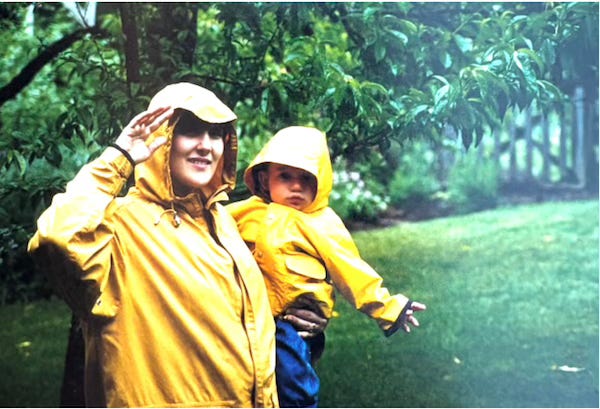
A day after she found the photos, Patricia Scanlon and Ricki Lake went on Instagram Live together to share their story.
Ricki said that after losing everything in the fire — particularly the photos she’d lost of her sons growing up — this experience “gives you hope for humanity.”
Ricki rejoiced that through a stranger’s insight and generosity, she was going to “get something back I thought was lost forever.”
A part of her memory map was returned.↓
We all map our individual worlds in language and memories, but until this week I did not know that this has been done for every corner of the globe.
While watching an embarrassingly bad spy thriller on Amazon Prime, I learned about what3words, a geocoding system created by entrepreneur Chris Sheldrick.
I was astonished to learn that our entire planet has been divided into a grid of 3-meter by 3-meter squares, each assigned a unique combination of three ordinary words.
To reduce confusion, similar-sounding combinations of words are kept geographically far apart.
How many squares are there covering our globe?
Approximately 57 trillion.
This means that every corner of our world — whether a lonely park bench or an unclimbed mountaintop; the center of a football field or the middle of the ocean — has a unique three-word address.
What3words works with 40,000 common words, but with that apparently you can capture the entire world.
(If you want to find out your three words — and remember you have a new set every time you walk ten feet in any direction — you can explore HERE).

Within the week the Patricia Scanlon / Ricki Lake story was picked up by People Magazine and even The New York Times.
Particularly in these chaotic times, I think we need stories like these about the power of human connection, especially if the focus is on the return of long-lost memories.
We need coherence and direction in our lives, especially when we’re planning a fresh start.
That’s why I’m extremely excited to offer a FREE event on New Year’s Day — and yes, there will be a replay if you think you’ll still be recovering at 3pm — that focuses on exactly this:
It’s not about writing as a method of “fixing you” and certainly not tattooing your new year’s resolutions on your skin with fresh ink.
Instead it’s about writing as a way of mapping out experience.
Elizabeth Bishop’s poem asks “Are they assigned, or can the countries pick their colors?”
When it comes to your own experience, I can answer that.
You do.
You get to not only pick the colors, you also get to select which memories you want to save in your box of photos… and which direction you want to travel to next.
Let’s find out that location — and maybe even its unique three-word description — together.
The Journey begins HERE.
Tell A New Story. Transform Your Life