

This week, life doubled down on an already uncanny synchronicity.
I’ve recently begun writing a new screenplay, something I haven’t done in several years.
The day before my haircut with my barber Mitch, I’d spent the night researching movies where one role is played by more than one actor at different ages.
The primary example ChatGPT offered was Tom Hanks’ Oscar-winning turn in Forrest Gump.
Imagine my surprise when I walked into the barbershop and, there on the widescreen TV, that movie was playing just minutes before the transitional scene.
I mentioned this to Mitch, who — exactly like ChatGPT — told me that the switch happens as Forrest discovers he can run.
Both of them, however, were dead wrong.
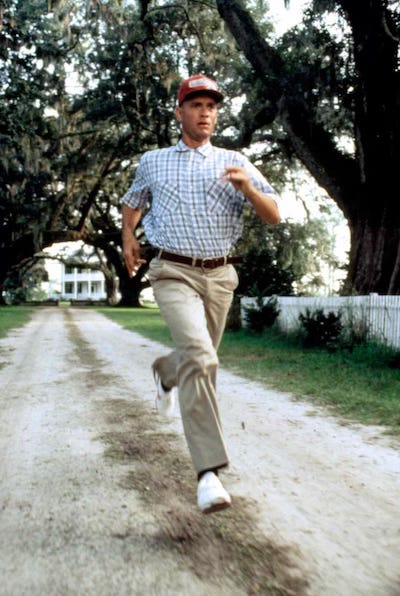
The change happens a few minutes AFTER the first running montage.
We see Forrest and Jenny from the back — identifiable by their haircuts and costumes — turning to the camera, except this time as their young adult selves, now played by Tom Hanks and Robin Wright.
The transition between actors works because we allow it.
The audience is willing to agree:
“Okay. I’ll buy it. That is the same person.”
It’s interesting that in a darkened theater, we grant narrative permission for identity to be swapped out quite conveniently.
But in real life?
Sometimes we don’t give that permission — this month’s meditation theme HERE — quite so easily.
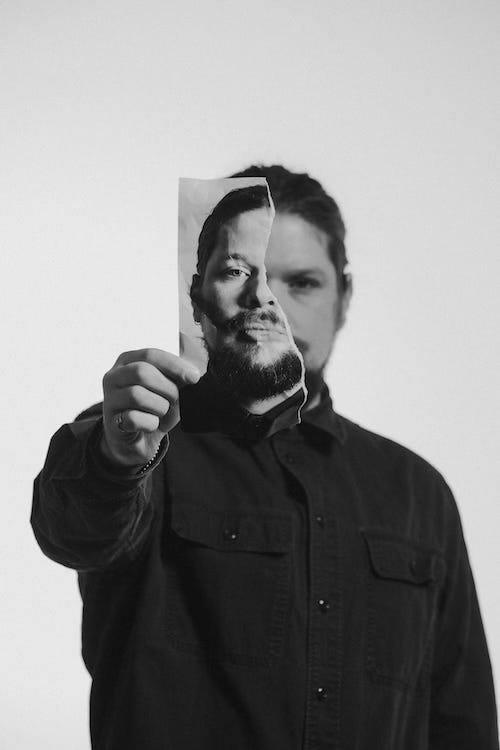
This month in the Transformation Book Club — you can join us HERE — we’re reading Elizabeth Gilbert’s Big Magic.
I’m struck that there’s an entire section of the book — between Enchantment and Persistence — about Permission.
One of her central theses is:
“You do not need anyone’s permission to live a creative life.”
Gilbert is adamant that you do not need credentials or validation.
You do not need to be chosen by anyone and you certainly don’t need to be fearless.
She argues repeatedly that you need self-authorization only, not in the sense of a coronation, but more simply as the decision to lead a creative life.
You get to choose the role, in other words… and you get to cast yourself.

The script I’m writing is a new challenge for me.
Other things I’ve written have been much more contained, often taking place over an evening or a few weeks, with either a straightforward leading man or woman or a small ensemble.
This one is different.
There are two parallel narratives that never directly intersect.
One takes place from 1933–1985 (a real person’s life); the other from 1975–present.
This does, however, present a bit of a thorny problem for the filmmakers.
It’s easy to throw in a childhood scene to fill us in on a character’s background… but it’s much harder if you need moments of someone’s life in their late teens and college years, and then also their late 40s.
Do you cast two different actors … or one actor you can age up or age down as needed?
Is the 45-year-old believable as a college student?
Or does the 25-year-old have the gravitas to play someone nearly defeated by life at 51?
Will the audience give you permission to change actors, to believe in a consistent identity being served by entirely separate individuals?
… Or is that cheating?

This week the very first podcast interview for my new book The Science of Getting Rich Journal was released.
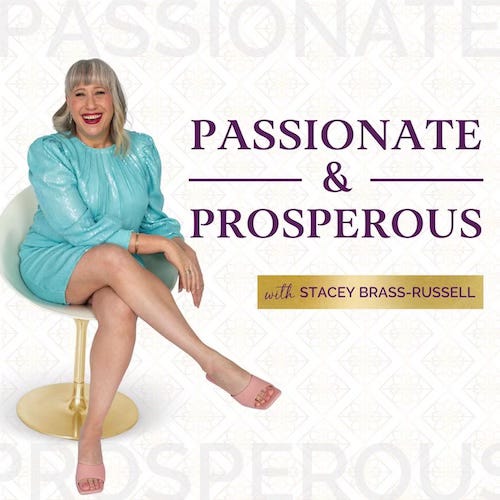
I was delighted to choose this for the launch, not just because it’s a top 200 Apple Podcast, but because the show — Passionate & Prosperous — is hosted by a dear old friend, Stacey Brass-Russell.
In fact, I first met Stacey over two decades ago on the first day of yoga school.
Stacey’s life has been one long, courageous reinvention—rooted in embodiment as much as creativity and ambition.
From performing in the original Broadway cast of Annie to becoming a master yoga teacher and studio owner, to building a multiple six-figure coaching business, Stacey now helps people navigate change, clarify their mission, and create deeply aligned success.
And she has a terrific podcast.
Like a well-cast film, her confidence and her passion allow us to embrace her in these different roles without confusion.
There’s a narrative coherence to it all, one that’s always inspiring.
You can listen to our lively conversation:
.
All this reminds me of a favorite poem by the Nobel Prize–winning poet Derek Walcott, Love After Love.
It centers on a kind of self-reconciliation, offering a possible future moment where one finally recognizes and embraces aspects of the self that may have been too long neglected.
Ending with a firm command, the poem isn’t about anything that smacks of narcissism.
Instead, it’s about a deep kind of inward homecoming, a permission to finally embody all of who you really are.
Love After Love
The time will come
when, with elation
you will greet yourself arriving
at your own door, in your own mirror
and each will smile at the other’s welcome,
and say, sit here. Eat.
You will love again the stranger who was your self.
Give wine. Give bread. Give back your heart
to itself, to the stranger who has loved you
all your life, whom you ignored
for another, who knows you by heart.
Take down the love letters from the bookshelf,
the photographs, the desperate notes,
peel your own image from the mirror.
Sit. Feast on your life.

Speaking of shifting roles…
Channeling is one of those spiritual phenomena that is way too easy to make fun of.
It can make people immediately brace themselves — images of trance states, disembodied voices, or someone claiming special powers.
I totally get the skepticism.
And yet, I have a few channeler friends whose work has helped so many people, I can’t reject it out of hand.
Chief among these is Daniel Scranton, a truly excellent human being who’s offering an entirely free workshop on March 2nd.
You can sign up for it HERE.
Dan views channeling as a natural ability that unfolds through practice, grounding, and self-trust.
And who knows…
Maybe when someone channels, they’re not contacting an external being — maybe they’re simply passing the microphone to a different role within themselves.
Indeed, it might be fascinating to see what that person has to say.
If you’re curious:

I thoroughly enjoyed the mini–Mandela Effect of both ChatGPT and Mitch the Barber getting the transition in Forrest Gump wrong.
They each misremembered the moment — when it’s really just a subtle turn-to-camera beat — turning it into part of an action montage.
Some transitions in life are indeed that dramatic, while others are utterly subtle.
In the same way, I’m still struggling to imagine what actor can handle a high school breakup as well as a midlife crisis — or whether that requires two separate individuals.
Elizabeth Gilbert consistently reminds us that we don’t need anyone’s permission to live a creative life.
I’d like to add that we can allow ourselves the same courtesy when it comes to transitions.
Allow yourself—and others—to change roles as often as you like without losing your sense of identity.
Play an orphan in Annie one day, then become a hugely successful business coach.
Or tap into your ability to channel higher-frequency beings and your spirit guides — or simply another part of your own vast consciousness.
As the poet writes, why not decide that today’s the day you “greet yourself arriving at your own door, in your own mirror” and “smile at the other’s welcome.”
Truly, you were born for the part.
Tell A New Story | Transform Your Life